A custom multi-agent orchestrator, built from scratch
AFO Agent OS
A 24/7 multi-agent AI system running my agency's operations: a Node orchestrator and workers on a VPS, PocketBase for state and memory, a Next.js command center on Vercel, and Telegram as the interaction surface — with an approval gate enforced in code.
- Context
- Self-directed
- Timeframe
- 2026 — active
- Node.js
- Next.js
- PocketBase
- Telegram Bot API
- VPS (Linux)
- Claude / LLM APIs
- MCP
- Vercel
The setting
My agency maintains a fleet of client sites and a stack of recurring operational work: check-ins, content updates, lead follow-ups, monitoring. That’s exactly the shape of work AI agents are good at — if you can trust them. The off-the-shelf answer was an existing open-source agent runtime. I evaluated it and decided to build my own orchestration layer instead.
That decision is the case study.
Why build instead of adopt
The runtime I evaluated had a consolidation problem: every subagent pinged me independently, which at any real scale turns “automation” into a second inbox. I could have patched around it. But I build to own it — and an agent system that acts on my business, with my credentials, is the last place I want a black box. So the orchestrator became mine: it consolidates all agent output into a single digest, and nothing outward-facing happens without passing an approval gate that is enforced in code. Not a prompt instruction an LLM might ignore. A code path that doesn’t exist without approval.
Where each piece lives, and why
Systems design here is mostly about placement constraints:
- The agent loop runs on a VPS as a long-running Node process — Vercel functions time out, and an orchestrator that needs to think for minutes can’t live in a 60-second box.
- The command-center UI is Next.js on Vercel — public, fast, and it means the VPS needs zero open inbound ports. The UI talks to state, not to the box.
- PocketBase holds data and memory — managed and boring until self-hosting is justified by real load. Managed-until-it-matters is a principle, not a compromise.
- Telegram is the interaction surface — the digest arrives where I already live, and approvals are one tap.
VPS — no open inbound ports
- Workers → Telegram directly: no per-agent pings
The threat model
Running a third-party agent runtime and my own system as the same OS user would mean a compromised runtime could read my .env and walk off with every credential I own. So AFO runs as a dedicated non-root afo user with chmod 600 on secrets, and the roadmap is per-container isolation with Docker — one blast radius per agent, not one blast radius for the business. Prompt-injection surfaces get the same treatment: anything an agent reads from the outside world is treated as untrusted input to the orchestrator, never as instructions with authority.
Scope discipline
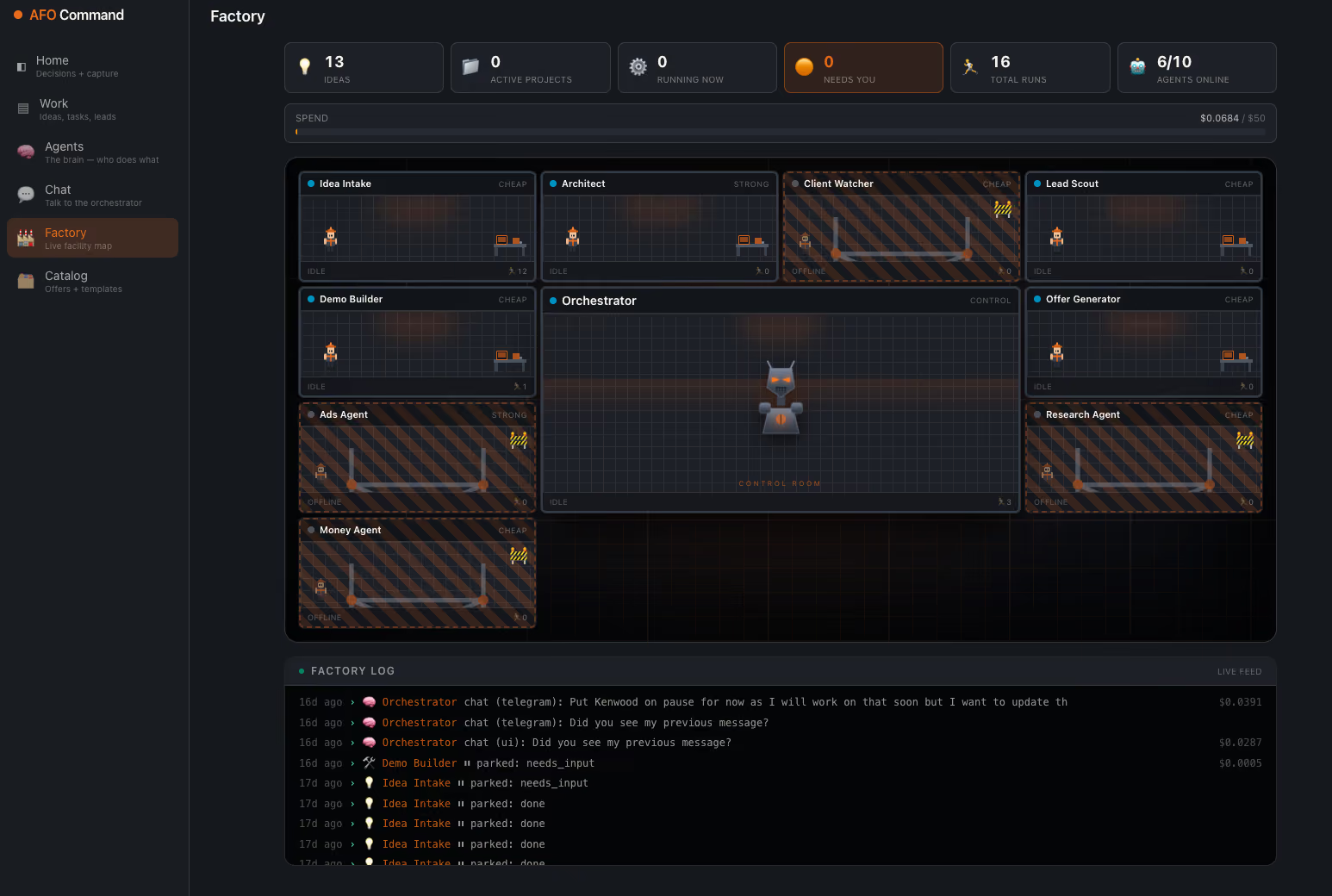
v1 is deliberately small: the orchestrator spine, idea intake, and a client-watcher targeting one concrete workflow — the biweekly client check-in — as the first proof point. Everything else is specified but dormant. (There’s also a Factorio-inspired “factory floor” visualization of the agents on the roadmap, because a system you can see is a system you debug faster — and because building things should be a little fun.)
Why this project matters to an employer
This is current, self-directed engineering in the part of the field that’s moving fastest — and it demonstrates the judgment that matters there: when to build versus adopt, where code must enforce what convention can’t, and how to threat-model a system that acts autonomously with real credentials.